





 Share
Share Add fave
Li Jin
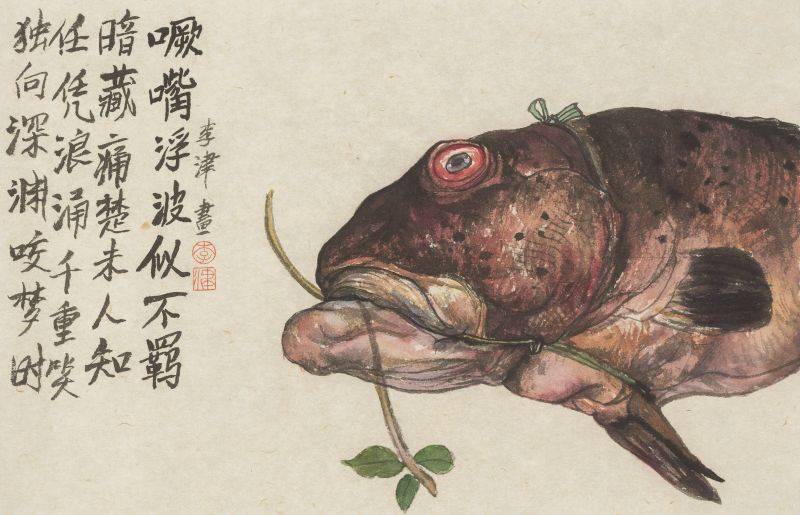
噘嘴鱼 Topmouth Culter Fish, 2025
Ink and Color on Paper, 23 x 35.5 cm
Chat with us on WhatsApp
About the artwork
噘嘴浮波似不羁
暗藏痛楚未人知
任凭浪涌千重笑
独向深渊咬 梦时
Lips pout, drifting like wild, restless waves,
Concealing sorrows that no one perceives.
Let a thousand tides rise with laughter’s roar,
Alone, I sink my teeth into the abyss of dreams.
噘嘴鱼 is exemplary of Li Jin’s practice, rooted in the immediacy of everyday life. During his residency across Southeast Asia, he wandered through markets, documenting the abundance of tropical produce, tasting street food and local cuisine. Rendered with remarkable specificity, each fish is depicted in close detail—its weight, texture, and presence carefully observed. The washes of ink and colour remain fluid and responsive, allowing scales, fins and flesh to emerge. Li Jin’s approach is neither idealised nor symbolic. Instead, the fish appear as they are: slightly ungainly, fleshy and real. Their expressions—wide-eyed, slack-jawed, or taut with tension—suggest moments suspended between movement and stillness. The compositions are intimate and direct, often isolating the fish against open space, drawing attention to form, gesture and texture. The accompanying calligraphy is executed with confident, rhythmic strokes, the text introduces a measured cadence that balances the physical immediacy of the fish.
About the artist
Li Jin (b. 1958, Tianjin, China) is one of China’s most beloved contemporary ink painters, celebrated for transforming everyday moment into colourful, whimsical narratives. A member of the New Literati movement, Li draws on the classical literati tradition and reinvigorates it with vivid humour and modern flair. His expressive brushwork and candid subject matter—full of food, sensuality, and playful self-portraits—redefine the boundaries of traditional ink painting.
Educated at the Tianjin Academy of Fine Arts (BA, 1983), where he later served as Associate Professor, Li Jin has exhibited globally in China, the U.S., Australia, Germany, and beyond. His works are in prestigious collections including the Metropolitan Museum of Art, the Museum of Fine Arts, Boston, Seattle Art Museum, National Art Museum of China, Hong Kong Museum of Art, and Ashmolean Museum, Oxford.
Indeed, even at their most extravagant, Li Jin's pleasures scenes are tinged with the melancholy of solitude and the unreality of a dream or a memory.